JB Music Co. - 16 / Jun / 2025
Acoustic Guitar Top Thickness: Why .100" vs .120" Matters for Tone and Durability

When examining acoustic guitar specifications, most players focus on body shape, tonewood species, and bracing patterns—but one of the most critical yet overlooked factors is soundboard thickness. The difference between a .100" (2.5mm) top and a .120" (3.0mm) top may seem negligible, yet this fraction of an inch dramatically influences how your guitar sounds, responds, ages, and withstands decades of playing. Understanding top thickness helps you select an acoustic guitar that matches your tonal preferences and performance requirements.
At Janzen Brothers Music Company, we stock acoustic guitars featuring various soundboard thickness specifications from the world's leading manufacturers. Whether you prioritize maximum responsiveness and dynamic range or prefer robust durability with controlled projection, understanding how top thickness affects performance empowers you to choose an instrument perfectly suited to your musical needs.
Understanding Acoustic Guitar Soundboard Thickness

The soundboard—also called the "top"—is the most acoustically significant component of any acoustic guitar. This thin wooden panel, typically crafted from spruce, cedar, or mahogany, functions as a diaphragm that transforms string vibrations into the rich, complex sounds we recognize as acoustic guitar tone. The thickness of this soundboard profoundly affects how efficiently and expressively it performs this critical function.
Standard Top Thickness Measurements
Acoustic guitar soundboards typically range from approximately .095" to .130" thick, with most falling into these common specifications:
- .095"-.100" (2.4-2.5mm): Thin tops, found on high-end fingerstyle guitars and vintage-style instruments
- .110"-.115" (2.8-2.9mm): Medium-thin tops, a popular modern standard balancing response and durability
- .120"-.125" (3.0-3.2mm): Medium-thick tops, providing enhanced durability and controlled projection
- .130" (3.3mm) and thicker: Heavy tops, typically reserved for guitars designed for high string tension or aggressive playing
The most common debate centers around .100" versus .120" tops—a mere .020" (0.5mm) difference that creates surprisingly distinct performance characteristics. Let's explore how this seemingly small variation impacts real-world playing and long-term ownership.
The Physics of Soundboard Thickness
To understand why top thickness matters, we need to examine the physics of how acoustic guitars generate sound. When you pluck a string, that vibrational energy transfers through the bridge into the soundboard. The soundboard then vibrates, displacing air and creating the sound waves we hear as guitar tone.
Mass and Resonance
Thinner soundboards have less mass, meaning they require less energy to set in motion. This lower mass allows thin tops to respond more readily to subtle playing nuances, vibrating more freely and producing greater volume from lighter touch. Conversely, thicker soundboards possess more mass, requiring more energy to achieve the same amplitude of vibration.
This mass difference affects several performance characteristics:
Dynamic Response: Thinner tops respond more dramatically to variations in playing dynamics, delivering greater contrast between soft and loud passages.
Harmonic Complexity: Greater soundboard movement in thin tops generates more complex overtone content, creating richer, more nuanced tonal color.
Efficiency: Less mass means energy transfers more efficiently from strings to air, producing more volume per unit of player effort.
Stiffness and Damping
Thickness also affects soundboard stiffness. Thicker tops resist bending more than thin tops, which influences how different frequencies resonate through the instrument. This stiffness affects:
Frequency Response: Thinner tops typically emphasize high frequencies and complex overtones, while thicker tops may emphasize fundamental notes with more controlled harmonic content.
Sustain Characteristics: The relationship between mass, stiffness, and internal damping affects how long notes ring and how they decay over time.
Tonal Focus: Thicker tops often produce more focused, direct tone, while thinner tops may generate more ambient, complex sound with greater tonal bloom.
.100" Tops: Maximum Responsiveness and Tonal Complexity
Guitars featuring .100" (or thinner) soundboards represent the responsive end of the acoustic guitar spectrum. These instruments prioritize maximum sensitivity to player input and complex tonal characteristics.
Playability and Response Characteristics
Thin-topped acoustic guitars deliver exceptional touch sensitivity:
Immediate Response: The soundboard reacts instantly to the lightest finger pressure, making these guitars incredibly expressive for fingerstyle playing. Subtle dynamic variations translate directly into volume and tonal color changes.
Wide Dynamic Range: The dramatic contrast between gentle and aggressive playing techniques allows expressive players to fully exploit their dynamic palette. Whisper-soft passages remain clear and present, while forceful attacks produce powerful volume without losing clarity.
Overtone Richness: Greater soundboard movement generates complex harmonic overtones that add dimension and character to every note. These overtones create the "singing" quality many players prize in high-end acoustic guitars.
Recording Excellence: The complex harmonic content and dynamic responsiveness of thin tops translates beautifully through microphones, capturing nuanced performances with remarkable detail.
Tonal Characteristics of .100" Tops
Acoustically, thin soundboards produce distinctive sonic signatures:
Open, Airy Quality: The free-vibrating soundboard creates an open, spacious sound with excellent harmonic bloom—notes seem to expand and develop after the initial attack.
Enhanced High-Frequency Detail: Greater treble presence and shimmer makes fingerstyle patterns and complex chord voicings sparkle with clarity.
Three-Dimensional Sound: The rich overtone content creates a complex, multi-layered tonal character that seems to fill acoustic space more completely.
Vintage-Inspired Voice: Many pre-war acoustic guitars featured thin tops, and modern thin-topped instruments often capture similar tonal characteristics that players associate with golden-era instruments.
Considerations with .100" Tops
While thin tops offer compelling advantages, they require specific considerations:
Climate Sensitivity: Thinner soundboards may be more susceptible to humidity-related movement, making consistent humidification especially important.
Playing Style Matching: These guitars excel with controlled technique but may become overly responsive or lose clarity with extremely aggressive playing styles.
Long-Term Monitoring: While properly braced thin tops prove durable, owners should monitor for soundboard bellying (swelling behind the bridge) over decades of string tension.
Premium Pricing: Thin-topped guitars often feature premium construction and careful bracing design, typically positioning them in higher price ranges.
Ideal Players for .100" Tops
Thin soundboards particularly suit:
- Fingerstyle guitarists who exploit subtle dynamic variations
- Recording artists seeking complex, detailed acoustic tone
- Players with controlled technique who appreciate maximum response
- Musicians who prioritize tonal complexity and harmonic richness
- Anyone seeking vintage-inspired tonal characteristics
.120" Tops: Enhanced Durability and Focused Projection
Guitars featuring .120" soundboards prioritize structural robustness and controlled tonal characteristics. These instruments deliver reliable performance across diverse playing styles and environmental conditions.
Structural Advantages of Thicker Tops
The additional mass and stiffness of .120" tops provide several practical benefits:
Enhanced Durability: Greater thickness better resists stress from string tension, temperature fluctuations, and physical impacts. These guitars typically withstand challenging conditions and aggressive playing styles with fewer structural issues.
Climate Stability: Thicker soundboards exhibit less dramatic response to humidity changes, maintaining more consistent playability and intonation across varying environmental conditions.
Resistance to Bellying: The increased stiffness helps prevent soundboard distortion behind the bridge, even after decades of continuous string tension.
Longevity: For guitars that will experience heavy use, frequent travel, or less-than-ideal storage conditions, thicker tops offer greater confidence in long-term structural integrity.
Performance Characteristics of .120" Tops
While thicker tops require more playing energy to achieve maximum volume, they offer specific performance advantages:
Controlled Projection: Rather than the wide-open response of thin tops, .120" soundboards deliver focused, direct projection that cuts through ensemble mixes effectively.
Clarity Under Pressure: These guitars maintain note definition even during aggressive strumming or forceful flatpicking where thin tops might become overwhelmed or compressed.
Consistent Response: Less dramatic dynamic sensitivity means more predictable response across various playing techniques and intensity levels.
Strong Fundamental Notes: Thicker tops emphasize fundamental frequencies rather than complex overtones, creating a clear, direct tonal character.
Tonal Profile of .120" Tops
Thicker soundboards generate a distinctive sonic signature:
Focused, Direct Tone: Clear, punchy sound with strong fundamental notes and controlled overtone content—excellent for rhythm guitar work and ensemble playing.
Powerful Projection: When played with authority, these guitars produce impressive volume that carries well in live performance situations.
Balanced Frequency Response: Even representation across the frequency spectrum without excessive emphasis on any particular range.
Reduced Overtone Complexity: More straightforward tonal character that some players find clearer and more musical in certain contexts.
Ideal Players for .120" Tops
Thicker soundboards particularly benefit:
- Strummers and rhythm guitarists who play with consistent intensity
- Bluegrass players and flatpickers who need clarity during aggressive playing
- Musicians performing in challenging environmental conditions
- Players seeking maximum long-term durability
- Anyone who prefers focused, direct tone over complex harmonic content
- Touring musicians whose instruments experience frequent travel and handling
The Middle Ground: .110" Tops
Many modern acoustic guitars feature .110" soundboards, attempting to balance the responsiveness of thin tops with the durability of thicker specifications. This middle-ground approach offers:
Versatile Performance: Good dynamic response while maintaining structural robustness for diverse playing styles.
Contemporary Standard: Many premium manufacturers have settled on .110" as an optimal balance point for modern players.
Broad Appeal: Suitable for players who want some of the benefits of thin tops without the extreme sensitivity or potential fragility concerns.
How Bracing Interacts with Top Thickness
Soundboard thickness doesn't exist in isolation—it works in concert with the bracing pattern to determine overall performance. Luthiers carefully calibrate bracing design to complement soundboard thickness:
Thin Tops and Aggressive Bracing
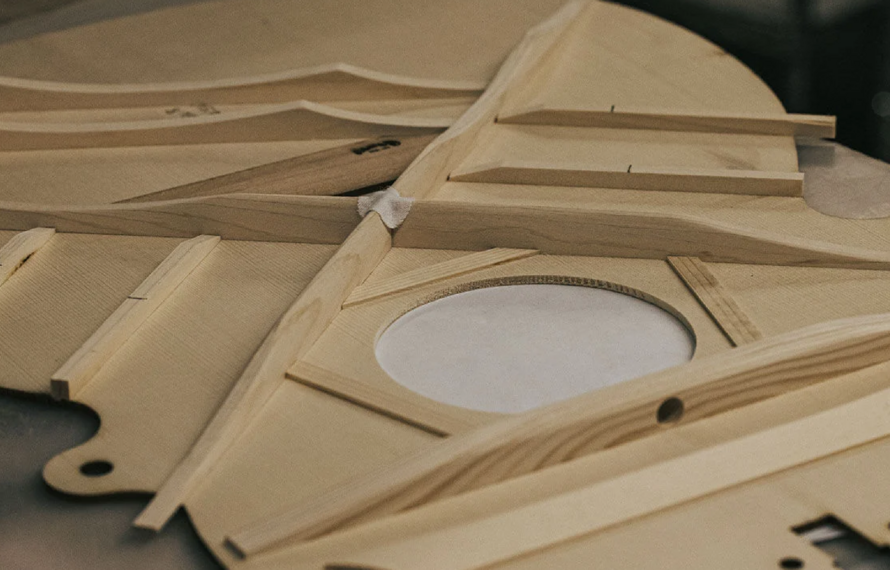
Guitars with .100" tops typically feature more substantial bracing to provide necessary structural support. This bracing must be carefully designed and often scalloped to maintain responsiveness while preventing soundboard failure.
Thick Tops and Lighter Bracing
Conversely, .120" tops require less supportive bracing since the soundboard itself provides greater structural integrity. This can allow luthiers to use lighter, less restrictive bracing that enhances response despite the thicker soundboard.
The Optimization Balance
Master luthiers spend careers optimizing the relationship between top thickness, bracing dimensions, bracing pattern, and tonewood selection. The goal is maximizing desired tonal characteristics while ensuring structural reliability over decades.
Top Thickness and Tonewood Species
Different tonewood species interact distinctly with various thickness specifications:
Spruce Tops
Spruce, the most popular soundboard material, works beautifully at any thickness:
- Thin spruce (.100"): Maximum brightness, clarity, and dynamic range
- Thick spruce (.120"): Controlled power with clear, focused projection
Cedar Tops
Cedar, being softer and less stiff than spruce, typically performs best with slightly thicker specifications:
- Thin cedar: Very responsive but may become overly loose or undefined
- Medium-thick cedar (.115-.120"): Optimal balance of warmth and clarity
Mahogany Tops
Mahogany tops, less common but valued for midrange focus, often feature thicker specifications to compensate for the wood's lower stiffness compared to spruce.
Real-World Examples: Professional Applications
Professional guitarists often choose top thickness based on their specific musical demands:
Studio Session Players: Frequently prefer .100" tops for their detailed, complex tone that captures beautifully through microphones.
Touring Performers: Often select .120" tops for reliability across varying venues, climates, and playing conditions.
Fingerstyle Artists: Typically gravitate toward thinner tops that respond to their controlled, nuanced technique.
Bluegrass Musicians: Often choose thicker tops that maintain clarity during aggressive flatpicking and powerful strumming.
Making the Right Choice for Your Playing
Selecting optimal top thickness depends on several factors:
Assess Your Playing Style
Dynamic Range Usage: If you exploit wide dynamic variations, thin tops reward that expressiveness. If you play with consistent intensity, thicker tops provide appropriate response.
Technical Aggression: Controlled, refined technique benefits from thin tops, while powerful, aggressive playing may overwhelm thin soundboards.
Musical Context: Solo fingerstyle performances showcase thin tops beautifully, while ensemble playing often benefits from thicker tops' focused projection.
Consider Your Environment
Climate Stability: Players in stable, controlled environments can confidently choose thin tops, while those facing temperature and humidity extremes may prefer thicker soundboards.
Travel Frequency: Guitars that travel extensively benefit from the durability of thicker tops.
Storage Conditions: If you can maintain ideal humidity and temperature, thin tops remain viable. Less controlled storage favors thicker specifications.
Evaluate Long-Term Priorities
Tonal Evolution: Some players value how thin tops "open up" and develop character over decades, while others prefer the consistent performance of thicker soundboards.
Maintenance Commitment: Thin tops require more vigilant monitoring and maintenance to ensure long-term health.
Resale Considerations: High-end thin-topped guitars often maintain value well due to their premium construction and desirable characteristics.
Experience Different Top Thicknesses at Janzen Brothers
Understanding top thickness in theory proves valuable, but experiencing these differences firsthand provides irreplaceable insight. At Janzen Brothers Music Company, our comprehensive acoustic guitar inventory includes instruments across the thickness spectrum from the industry's finest builders.
Our knowledgeable team can help you identify which soundboard thickness aligns with your playing style, environmental conditions, and tonal preferences. We encourage you to explore guitars with different specifications and discover how these measurements translate into real-world performance differences.
Conclusion: The Critical Balance
Soundboard thickness represents one of the most significant yet least discussed specifications in acoustic guitar design. The difference between .100" and .120" tops—a mere .020" of wood—profoundly affects responsiveness, tonal complexity, projection characteristics, and long-term durability.
Thinner tops reward refined technique with exceptional expressiveness and complex harmonic content, while thicker tops provide robust reliability with focused projection and consistent response. Neither approach is objectively superior—they serve different musical needs and player priorities.
Visit our extensive collection ofacoustic guitars at Janzen Brothers Music Company to explore instruments featuring various soundboard thickness specifications. Whether you prioritize maximum responsiveness, enhanced durability, or carefully balanced versatility, your ideal acoustic guitar awaits.
Understanding how seemingly small specifications create significant performance differences empowers you to select an instrument that will inspire your playing for decades to come. Start your journey toward the perfect acoustic guitar today.
Ready to find an acoustic guitar with the ideal soundboard thickness for your playing style? Browse our complete selection at Janzen Brothers Music Company. With expert guidance, Canada-wide shipping, and our commitment to 100% customer satisfaction, discover how top thickness affects the acoustic guitar that becomes your musical voice. Shop our acoustic guitar collection today!