JB Music Co. - 03 / Jun / 2025
The Science of Acoustic Guitar Bracing Patterns: X-Bracing vs Scalloped vs Forward-Shifted
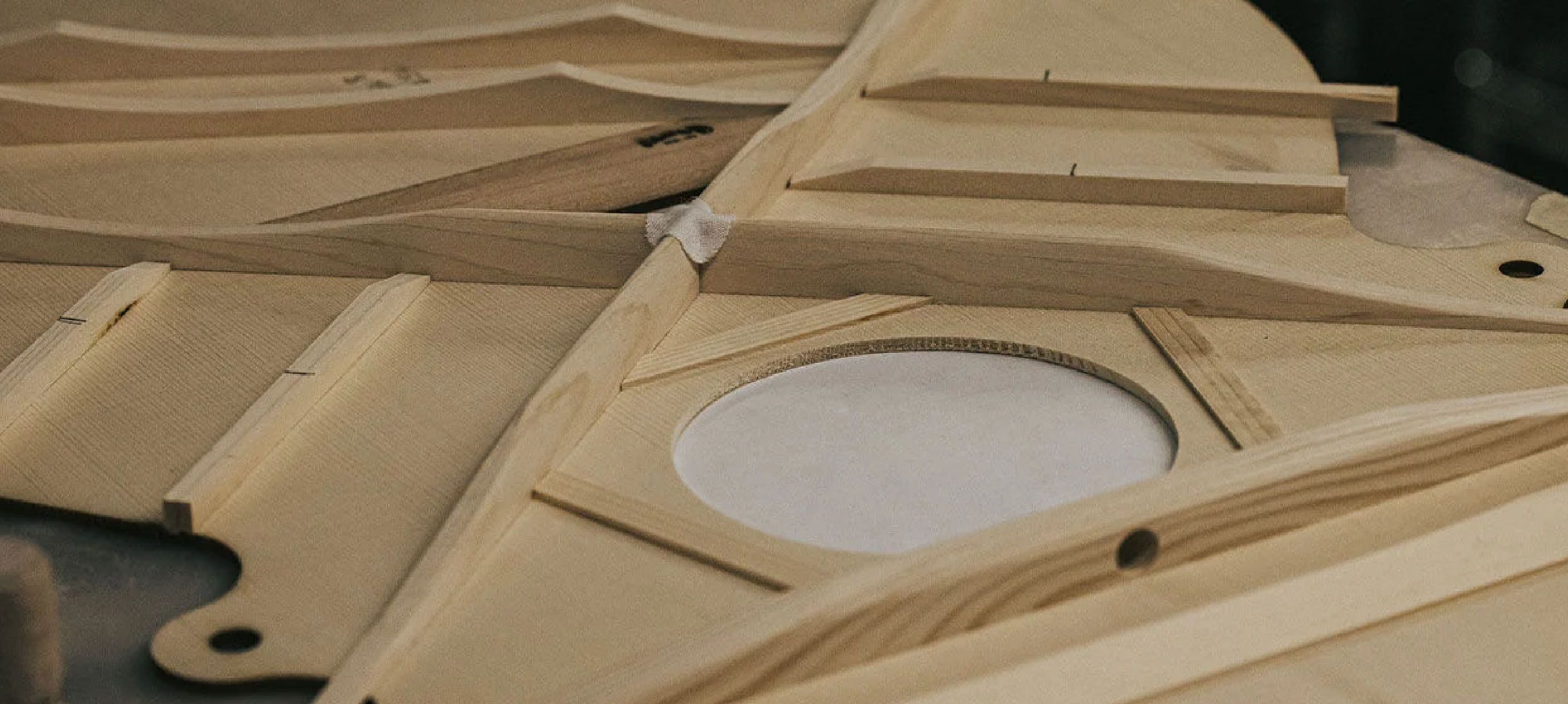
When you play an acoustic guitar, you're not just hearing strings vibrating—you're experiencing a precisely engineered acoustic chamber where every structural element contributes to the instrument's voice. Among these critical components, the bracing pattern hidden beneath the soundboard plays a pivotal role in shaping tone, volume, sustain, and overall sonic character. Understanding the science behind different bracing patterns can help you make informed decisions when selecting your next acoustic guitar.
At Janzen Brothers Music Company, we offer acoustic guitars featuring various bracing designs, each engineered to deliver specific tonal characteristics. Whether you're a fingerstyle player seeking clarity and balance, a strummer demanding power and projection, or a recording artist chasing nuanced dynamics, the bracing pattern significantly influences your instrument's performance.
What is Acoustic Guitar Bracing?

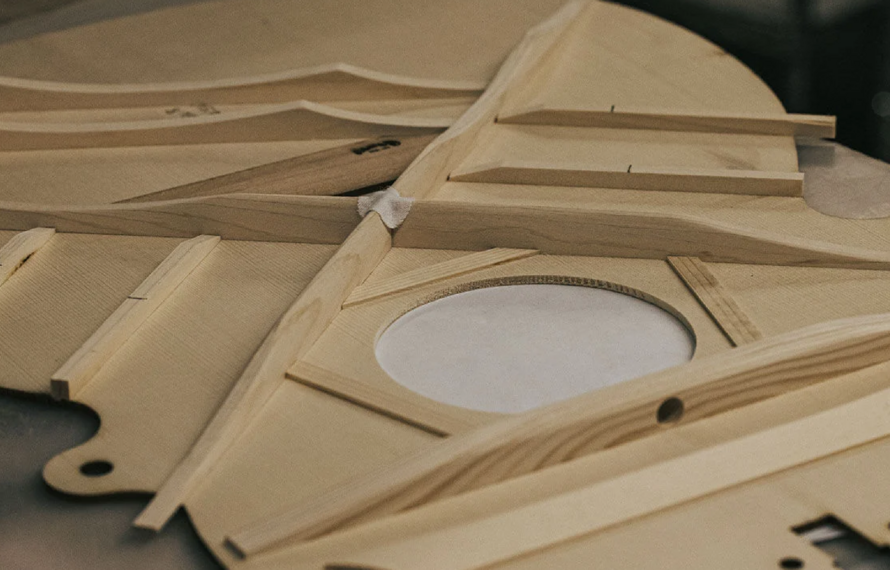
Before diving into specific patterns, let's explore what bracing actually does. Acoustic guitar bracing consists of wooden struts glued to the underside of the soundboard (top). These struts serve multiple crucial functions:
Structural Support: The soundboard must withstand approximately 180 pounds of string tension while remaining thin enough to vibrate freely. Bracing provides essential reinforcement that prevents the top from warping, cracking, or collapsing under this constant stress.
Tonal Shaping: Different bracing configurations create distinct vibration patterns across the soundboard. By controlling how and where the top flexes, luthiers sculpt the guitar's frequency response, affecting bass response, midrange presence, and treble clarity.
Volume and Projection: Bracing influences how efficiently the soundboard converts string energy into acoustic sound waves. Strategic placement and shaping of braces can enhance volume and projection without sacrificing tonal complexity.
Sustain and Resonance: The way braces allow or restrict soundboard movement directly impacts how long notes ring and how freely the instrument resonates. Finding the optimal balance between stiffness and flexibility is the luthier's perpetual challenge.
Traditional X-Bracing: The Foundation of Modern Acoustic Tone
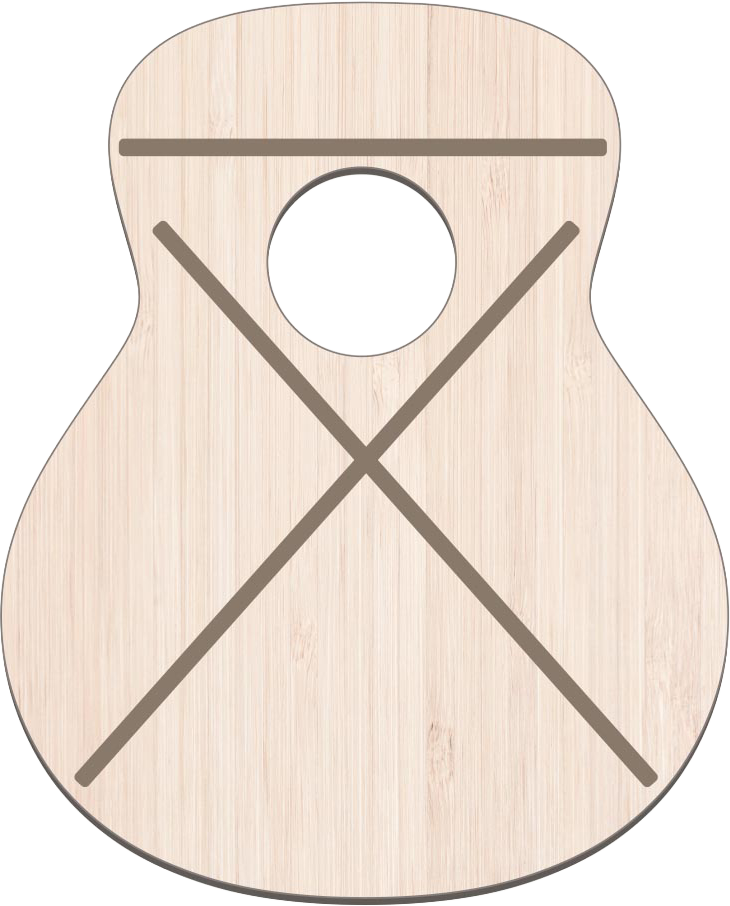
Developed by C.F. Martin in the mid-1800s, X-bracing revolutionized acoustic guitar construction and remains the most widely used bracing pattern today. This design features two main braces that cross beneath the soundhole, forming an "X" shape, with additional tone bars and finger braces supporting other areas of the soundboard.
The Physics Behind X-Bracing
X-bracing creates a balanced structural framework that distributes string tension evenly across the soundboard while allowing strategic areas to vibrate freely. The intersection point of the X—typically positioned just below the soundhole—acts as a fulcrum that influences how the upper and lower bouts respond to different frequencies.
The upper bout (above the soundhole) primarily influences treble and midrange frequencies, while the lower bout (below the bridge) significantly affects bass response. X-bracing coordinates these sections to work together, creating the balanced, full-spectrum tone that defines the modern acoustic guitar sound.
Tonal Characteristics of Standard X-Bracing
Guitars with traditional X-bracing typically offer:
- Balanced frequency response across the tonal spectrum
- Strong fundamental notes with clear note definition
- Predictable, consistent tone that works well across musical styles
- Good projection suitable for ensemble playing and solo performance
- Moderate sustain with controlled overtones
Standard X-bracing excels in situations requiring clarity and balance. Whether you're fingerpicking intricate passages, strumming rhythm parts, or flatpicking lead lines, X-braced guitars provide reliable, even response that helps every note shine through the mix.
Modern Variations on X-Bracing
Contemporary luthiers have developed numerous X-bracing variations to optimize specific performance characteristics. Some builders adjust the angle of the X, alter the height and width of individual braces, or modify the placement of supplementary braces. These refinements allow manufacturers to fine-tune instruments for particular playing styles while maintaining the fundamental benefits of the X-bracing architecture.
Scalloped Bracing: Unleashing Dynamic Response

Scalloped bracing represents a significant evolution in acoustic guitar design. This technique involves carving away portions of the bracing material, creating a scalloped or wave-like profile along each brace. Rather than changing the fundamental bracing pattern, scalloping modifies how existing braces interact with soundboard vibration.
The Engineering Behind Scalloping
When you scallop braces, you reduce their mass while maintaining structural integrity at critical points. This selective material removal allows the soundboard to vibrate more freely in specific zones while preserving strength where needed most. The result is increased soundboard flexibility without compromising structural stability—a delicate balance requiring significant skill and experience.
The depth, width, and location of scallops can be precisely tailored to emphasize different tonal qualities. Deeper scalloping generally permits greater soundboard movement, producing more volume and enhanced dynamic range. Shallower scalloping provides subtle improvements while maintaining more traditional tonal characteristics.
Tonal Benefits of Scalloped Bracing
Acoustic guitars featuring scalloped bracing typically exhibit:
- Enhanced dynamic range: Greater responsiveness to playing dynamics, from whisper-soft passages to powerful attacks
- Increased volume and projection: More efficient energy transfer results in louder acoustic output
- Extended bass response: Greater lower bout flexibility enhances low-frequency resonance
- Complex overtones: Freer soundboard movement generates richer harmonic content
- Improved sustain: Less dampening allows notes to ring longer
Scalloped bracing particularly benefits fingerstyle players who exploit dynamic nuance and need their instruments to respond to subtle touch variations. Recording artists also appreciate the enhanced harmonic complexity that translates beautifully through microphones.
Considerations with Scalloped Bracing
While scalloped bracing offers compelling advantages, it requires careful implementation. Overly aggressive scalloping can compromise structural integrity, potentially leading to soundboard distortion or premature failure. Quality instruments from reputable manufacturers use time-tested scalloping techniques that balance performance enhancement with long-term durability.
Additionally, scalloped-braced guitars may require more frequent setup adjustments as the more responsive soundboard can be slightly more sensitive to humidity and temperature changes. Proper humidification and care become even more important with these instruments.
Forward-Shifted Bracing: Redefining Acoustic Architecture
Forward-shifted bracing, pioneered by master luthier Andy Powers at Taylor Guitars (called "V-Class" bracing), represents one of the most significant innovations in acoustic guitar design in recent decades. This revolutionary approach fundamentally reimagines how bracing supports the soundboard and generates tone.
The Revolutionary Design Philosophy
Traditional bracing patterns, including X-bracing, create some inherent compromises. The crossing braces can restrict soundboard movement in certain areas while potentially creating conflicting vibration patterns. Forward-shifted designs eliminate the X-pattern entirely, instead using braces that run more parallel to the strings and are positioned differently relative to the bridge.
In forward-shifted configurations, braces are moved forward (toward the neck) compared to traditional placement, and they often extend from the soundhole area down past the bridge in a more parallel arrangement. This design allows the soundboard to flex more uniformly along the length of the strings while providing strategic reinforcement where needed.
The Science of Parallel Bracing Geometry
Forward-shifted parallel bracing creates what engineers call "orderly stiffness"—meaning the soundboard flexes consistently and predictably along the string axis rather than creating competing vibration nodes. This results in several measurable improvements:
Enhanced Intonation: More uniform soundboard flex means strings vibrate more true to their mathematical harmonic series, reducing the slight pitch anomalies that can occur with traditional bracing. This creates noticeably improved intonation, especially in the upper register.
Increased Sustain: With less conflicting soundboard motion, energy transfers more efficiently from strings to air, and notes ring longer with consistent volume decay rather than rapidly fading or exhibiting uneven sustain across different strings.
Greater Volume Consistency: Forward-shifted designs often produce more even volume across the entire fretboard, eliminating "dead spots" or quieter notes that can plague traditionally-braced guitars.
Tonal Signature of Forward-Shifted Bracing
Guitars utilizing forward-shifted bracing designs deliver distinctive sonic characteristics:
- Exceptional sustain: Notes ring longer with more consistent decay
- Superior intonation: Improved pitch accuracy across the fretboard
- Balanced volume: Even response from low to high registers
- Clear note separation: Enhanced clarity when playing chords or complex passages
- Modern, articulate tone: Contemporary voice that works beautifully for recording
Forward-shifted bracing particularly excels for players who need pristine intonation and note-to-note consistency—valuable qualities for session musicians, recording artists, and performers playing in acoustically challenging environments.
The Trade-offs with Forward-Shifted Designs
While forward-shifted bracing offers impressive technical advantages, some players perceive the tone as less traditional compared to X-braced instruments. The enhanced clarity and accuracy may come at the expense of some of the complex, slightly unpredictable character that many musicians associate with vintage acoustic tone.
Additionally, forward-shifted bracing patterns are typically found in higher-end instruments due to the precision required in their construction. However, as with any premium feature, the investment often proves worthwhile for players who benefit from the specific performance characteristics these designs provide.
Choosing the Right Bracing Pattern for Your Playing Style
Understanding bracing patterns helps you select an acoustic guitar that matches your musical needs:
Traditional X-Bracing suits players who:
- Value classic acoustic guitar tone and response
- Play multiple musical styles and need versatility
- Prefer predictable, balanced performance
- Want time-tested reliability and easier maintenance
- Appreciate the heritage of traditional acoustic design
Scalloped Bracing benefits players who:
- Prioritize dynamic expression and touch sensitivity
- Need maximum volume and projection for performance
- Enjoy rich, complex harmonic overtones
- Play fingerstyle or delicate acoustic arrangements
- Want enhanced bass response for full-bodied tone
Forward-Shifted Bracing appeals to players who:
- Demand precise intonation and note accuracy
- Record frequently and need consistent studio performance
- Value extended sustain and even volume across the range
- Appreciate modern acoustic design innovations
- Play intricate passages requiring exceptional clarity
Experience Different Bracing Patterns at Janzen Brothers
The best way to understand how bracing patterns affect tone is to experience them firsthand. At Janzen Brothers Music Company, our diverse acoustic guitar inventory includes instruments featuring various bracing designs from the world's leading manufacturers.
Whether you're drawn to the time-honored warmth of traditional X-bracing, the enhanced dynamics of scalloped designs, or the technological sophistication of forward-shifted patterns, we stock acoustic guitars that showcase the finest examples of each bracing philosophy. Our knowledgeable team understands the technical nuances that distinguish these designs and can help you find an instrument whose bracing pattern complements your playing style.
The Future of Acoustic Guitar Bracing
Bracing pattern innovation continues to evolve as luthiers combine traditional wisdom with modern engineering tools. Computer modeling, finite element analysis, and acoustic testing allow contemporary guitar makers to predict and optimize soundboard behavior with unprecedented precision.
Some manufacturers experiment with hybrid bracing systems that incorporate elements from multiple patterns, seeking to capture the best characteristics of each approach. Others explore entirely novel configurations that challenge conventional acoustic guitar architecture. These ongoing innovations ensure that acoustic guitar design remains a vibrant, evolving art form.
Conclusion: Let Your Ears Decide
While understanding the science behind bracing patterns provides valuable context for informed guitar selection, ultimately your ears and hands should guide your decision. Each bracing design offers distinct advantages, and personal preference plays an enormous role in determining which sonic character resonates with your musical voice.
Visit our extensive collection of acoustic guitars at Janzen Brothers Music Company to explore instruments featuring different bracing patterns. Whether you're upgrading your current guitar or selecting your first serious instrument, understanding how bracing influences tone empowers you to make choices that will enhance your musical journey for years to come.
The perfect acoustic guitar awaits—one where every design element, from bracing pattern to tonewood selection, combines to create an instrument that inspires your creativity and faithfully expresses your musical vision. Start exploring today and discover how the hidden architecture beneath the soundboard shapes the voice of your next acoustic guitar.
Ready to find your perfect acoustic guitar? Browse our complete selection at Janzen Brothers Music Company and experience the difference that quality bracing design makes. With Canada-wide shipping and our commitment to 100% customer satisfaction, your ideal instrument is just a click away.